Tuesday, 29 October 2013

...I would not have a boring vacation (Part 1)


Peace Pagoda
            A couple weeks ago was Dashain, the longest holiday in Nepal, so a few friends and myself decided to head off to Pokhara for our time off, a city in central Nepal near the Annapurna mountain range. It took about 6-7 hours by bus to get there from Kathmandu. Our first full day in Pokhara, Peter, Sumbal and I decided to hike up to the Peace Pagoda, one of 80 Peace Stupas around the world that were built to represent world peace following the bombing of Hiroshima in 1947. There are two ways to reach the stupa, either a 2-hour hike from the back of the hill, or ferry across Fewa Lake and climb up the stairs. We opted to try both, hiking up and going back down to Pokhara by boat.

            The next day, I began a five-day trek with my friends Juliana, Luzianne, Peter, and Lisa in the Annapurna Conservation Area. We started from Nayapul, just over an hour’s drive outside of Pokhara. We went with a guide and two porters. We asked our guide if we can push ourselves more during the trek and were able to fit a 6-day trek into 5 days. About an hour into the trek we stopped and filled up our water bottles and I set my camera on the ground to put in iodine drops (to kill any bacteria in the water that might upset our stomachs). And being my usual forgetful self, I left the camera there and when I went back 5 minutes later it was gone. Fortunately it was an old camera and not a big deal but it means all the photos from the trek here are stolen from my friends.
The Route: Nayapul-Ulleri-Ghorepani-near Tadapani-Jhinu-Nayapul

The first day was mostly stairs and by the end of the day we’d climbed more than 3000 stairs. Our guide kindly warned us not to get too close to the donkeys on the path as sometimes they are prone to shoving people off. We were passing lots of people as we went, which became a theme of the trek, and I was absolutely drenched in sweat and actually wrung out my headband halfway through. The villages we passed through during the trek were absolutely picture perfect. As we climbed higher and higher, we could see the rolling hills of forest and rice terraces and as tired as I was by the end I just didn’t feel it because of how amazing it was to be there. The lodges we stayed at turned out to be much nicer than I expected. I’d been anticipating very basic lodging and food but they ended up having showers (although freezing cold from the glacier-fed water- unless you paid for a hot shower), cozy lounge areas and a delicious variety of food.
Enjoying the rain!

            The next two days of the trek consisted of constant rainfall, mud, leeches and a serious lack of mountain views. During these days I was grateful for the group of friends I went trekking with. Although the weather was miserable and we were soaked through even our rain gear, for the most part we were still in great spirits, making jokes about the situation. Rain during this time of year is extremely abnormal and October is supposed to be one of the best times to hike in Nepal. Our guide let us know that it was the muddiest conditions he’d ever walked the path on, despite having hiked the trail too many times to count over the past 18 years. At times, the path had even turned into a stream from so much water. Personally, I think the rain almost made it more beautiful at times because we were hiking through the rainforest, passing countless waterfalls and streams. With all the water, most of us got leeches. I was lucky and only got one on my foot. Lisa somehow managed to get them on her stomach.

Poon Hill photo as I imagine it
We were also supposed to hike up to Poon Hill on the third day from Ghorepani at 4:30am to get a sunrise view from the hill. It’s supposed to be the most picturesque sunrise views of the Annapurna range. However, we wouldn’t have been able to see anything because of the weather, so got some extra sleep instead. To make up for the lack of picture, I created my own picture about what I imagine our photos would have looked like.

            On the fourth day, the rain cleared a bit but it was still too overcast to see anything. However, our day really brightened when we reached Jhinu, where there is a natural hot springs. Of course we spent the entire afternoon there. The spring was about a 20-minute hike from the lodge (which I did four times due to a mid-afternoon beer run) and we had a much-needed relaxing day. When we first got there (around 1pm) we were the only ones at the spring for over an hour. Near the end of the afternoon when the pool was pretty full, the hot springs attendant came over and pointed at each of us in our group to get out. Yes, we got kicked out of the hot springs. I’m not sure why we got kicked out, maybe we’d been there too long, but we did a walk of shame out past everyone else and hiked back up to the lodge.

Morning of the fifth day...finally sunny
            On the fifth and final day of the trek the sun finally came out! Unfortunately for us, we were past the best mountain views so never actually got any good photos of the mountains. The last day ended up being the longest and we were completely exhausted for such a short trek. We had our celebratory last meal together and all (except Peter) ate our daal bhaat lunch with our hands as the locals do. Daal bhaat is a plate with rice, daal (lentil soup), vegetable curry, saag (steamed greens), and pickle, and when you order it you can eat as much as you want and they will keep bringing you more. Although we didn’t have the most ideal situations for the trek, I think we got quite a more exciting experience and loved every minute of it.

And here's some more photos...
Enjoying the hot springs
View from the Peace Pagoda


Thursday, 17 October 2013

...I would see the adverse impacts of deforestation


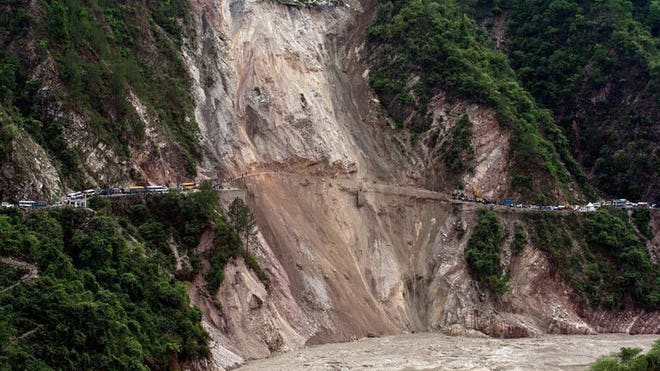
Landslide
When I was flying to Nepalgunj during my field trip a few weeks ago, I was looking out my airplane window and all I could see was hills and hills of forests. I know that deforestation is one of Nepal’s largest problems but it seemed to me that there was so much forest,how could it be such a problem? But as I looked a little closer, I began to see it: small areas around villages were missing areas of trees. Much clearer to me was some of the secondary effects of deforestation in Nepal. Throughout many of the hills, I could see areas where landslides had occurred. As well, many of the crop areas were very dry, and food was struggling to grow in these areas. 
Collecting Wood
These are just some of the effects of deforestation in Nepal and once I was in the villages, it became even more obvious of the impact of deforestation and climate change. When I got up at 6am for a walk one morning in Dailekh, I saw multiple women with heavy loads coming back from collecting fuelwood. I don’t know how far they had to walk, but it was probably fairly far as there were no forests right in Dailekh. They would go out and collect wood every single day. I also saw a lot of evidence of landslides from the ground, which will only become more severe as deforestation increases and climate change becomes more significant. Tree roots are a very important part of the hill ecosystem. They hold the soil intact to prevent erosion and landslides, and are also very important for holding in water. Areas that have less trees end up not having enough water because there is nothing to hold it in place. Lack of water then makes it difficult for the local population in both attaining drinking water and growing food. 
For these reasons, I actually can see the importance of the project I’m working on here, the Multi Stakeholder Forestry Project. The project is working in some of the western hills districts to help communities self-manage their local forests to prevent some of these effects and prevent further effects of climate change. Although the project has just begun this past year, I’m confident that IDS Nepal is going to make a difference in the sustainable management of forests.

*The photos in this post are not my own but representative of some of the effects I've seen.

Thursday, 10 October 2013

...I would finally get into a routine...and then leave on holiday

I’ve now been in Nepal almost exactly a month and I feel I’ve finally started getting into a routine. This week is my second actual week of work and although it started pretty slowly, I’ve now got work to do now keeping me busy. I’m currently working on updating our organization’s website content because it has not been updated since Nafisa (an Indev student from last year) was here. The organization is getting a completely new website made and it’s my job to update and prepare the content for the new site. During the week, I work from 10-5, Monday to Friday. Typically, the Nepali workweek is Sunday to Friday, but we are able to take Sunday off as well, which allows us to see more of the area. I’m luckier than most of my peers here because my commute to work is only a 5 minute walk. This means I have a lot more free time that I can use to get things done or explore the neighbourhood (or lay in bed and sleep longer!). I can leave the house at 9:55am and still make it to work on time.

Thanksgiving Dinner
Last weekend, we celebrated Thanksgiving here early. I was surprised at how easy it was to get most of the supplies for our dinner and we spent the day cooking a huge Western feast with chicken, mashed potatoes, salad, two kinds of beans, honey glazed carrots, stuffing, cauliflower, fresh bread and Nutella cheesecake brownies and apple crisp for dessert. We ate by candlelight on the roof of the CECI Passage House. It was really nice to have that taste of home. On Sunday we also went shopping, which I’ve been looking forward to, and I bought 2 kurtas (typical Nepali dress). I’m also looking forward to going sari shopping soon.

In Nepal, it’s currently Dashain, the biggest holiday of the year. It started on Saturday but most people still work during this week. It’s a Hindu festival but is celebrated by everybody in Nepal, regardless of religion. Most people here compare it to our Christmas and lots of people leave Kathmandu to go back to their villages to be with their family. On the 8th day of Dashain, there are lots of animal sacrifices to the goddesses across the country and after rituals are performed at the temples, the meat from the sacrifices are cooked and eaten. Even many people who are normally vegetarian partake in eating the meat sacrifice during this feast. There are other aspects of Dashain that I have already seen. Buying and wearing new clothing is part of the festival, and while shopping last weekend, the streets were packed and many shops had “Dashain discounts”. As well, across the country, large swings are set up for the children to use. There is one large bamboo swing just down the street from me. Dashain is a large festival here and it’s amazing that we are able to be here during this holiday.
Bamboo Swing in our Neighbourhood

For our Dashain holidays, Peter, Sumbal and I are headed to Pokhara on Friday. Peter and I are heading on a 5-day trek starting on the Sunday with three other Canadian volunteers, Juliana, Lisa, and Luzianne (Sumbal opted not to do the trek). We may also try to fit in some other fun activities like rafting or paragliding. Pokhara is a city just south of the Annapurna mountain range in Mid-Nepal. It’s supposed to be beautiful and there are tons of adventure activities to do there. I’m sure when I get back from our adventure I’ll have a lot more to tell about it.

Monday, 30 September 2013

...I would get sent right into the field

There’s only one way to describe speeding along a steep, narrow, winding mountain road at 70km/h, playing chicken with cars coming the other way: FUN! That’s how my field trip began a week ago as I made my way to Dailekh, a town in the hills of Nepal’s Mid-Western Region.

Journey to the field
Although I've only even been to my Kathmandu office for one day, I've already had the chance to do a week-long field trip. The field trip started with an hour-long domestic flight from Kathmandu to Nepalgunj, a city along the Indian border in the Terai region. We then loaded our gear into a car and started the ~6 hour drive to get to Dailekh. I loved the beautiful drive through the hills, although at times it was actually a little scary (like when we drove through the clouds along a cliff and couldn’t see more than 10 feet in front of us). But I enjoyed every minute of it! Yet, I was still flabbergasted when one of my coworkers slept through most of the ride. Between the bumps and honking as we whipped around every corner, I didn’t think anybody could possibly sleep. Yet, by the time we left 6 days later, I was so used to it that I was the one falling asleep, squished in the backseat of a car with 3 other people. Along the drive, it became clear to me that not many foreigners visit that area. As we drove by, jaws literally dropped, and I received many gaping stares. Children that recovered in time from the shock shouted “Hello” or “Bye-bye” as we drove past.

Views from a temple in Dailekh
During my time at the Dailekh office, I got to experience what life is like for the field staff. Their work and social lives overlap so their interactions are bit different than the Kathmandu office, as coworkers are good friends as well. Despite some homesickness while I was there, I really enjoyed my time there with the staff and learned a lot about the project I’ll be working on over the next months.

During my week, I also got the opportunity to go on a field visit to a small village district called Khadkawada with Rudra, the head of the MSFP project. To get there, I rode on the back of Rudra’s motorcycle and it gave me a whole new perspective on the car ride through the hills. We went off the main road down a muddy, rocky path along a cliff. Luckily, the motorcycle only slipped a few times, and we only ended up in the mud once. The ride was probably also the most intense ab and thigh workout I’ve ever had, trying to keep my body in one position for about 40 minutes each way. It was definitely both a physical and emotional roller-coaster the entire time.

A light taste of my motorcycle trip


Interviewing Santi and Masare
Once in the village, I got to attend a 2-day LAPA (Local Adaptation Plan of Action) workshop for the forestry management project with a group of about 40 local villagers. Although I couldn’t understand what was said, since it was all in Nepali, it was fascinating to watch the interactions of the villagers, and the passionate participation by everyone, and despite the language barrier I learned a lot in the 2 days. I also got to interview five locals for a field placement assignment, and it gave me
a lot of insight into their lives and their opinions on the project. At the end of the second day, I was incredibly lucky and the village performed a farewell ceremony, and Rudra and I received flower garlands and red powder on our foreheads. I hadn’t expected such a ceremony, since I merely a spectator during the event, and it was truly an honour. The entire field trip was an amazing experience and was exactly what placement is all about!

Farewell ceremony

Friday, 20 September 2013

...I would take in all the sites of a new city

It’s now been nearly two weeks since we landed in Kathmandu and I feel like it’s been a month with everything we’ve fit into the short time we’ve been here so far. I came to Nepal with four other INDEVOURS: Chelsea, Rasha, Sumbal and Peter and there are also 6 other CECI volunteers going through orientation with us.

Thali dinner
            When we first got here I was surprised by how comfortable I already was with a foreign place, but, like it was when I went to Madagascar, I seem to adapt quickly to my surroundings. Sure there are lots of things that are different here: constant noise and honking, showers where the water goes directly onto the floor, cows and dogs everywhere in the streets. But generally, life is the same. The people here are the nicest people as well. I think of Nepal to India/China as Canada is to the U.S. The people here are very laid back and friendly
and try to differentiate themselves from the bigwigs north and south of them (they even have their own time zone- 15 minutes off).

            This week we’ve been studying the language of Nepal: Nepali. We got a week of full-day Nepali lessons and I think the week of language has helped ease us into the culture a little more before starting work. I actually started off learning it quite quickly and can speak a few basic sentences. Hopefully I can keep practicing though and ideally I’ll be fairly fluent in the language by the time I leave. A few of us are looking into continuing language classes a couple times a week for the rest of 8 months. When practicing, Chelsea and I have been especially creative in the sentences we make up and it’s helping me remember the language better.

Women celebrating Rhishi Panchami
            In the time I’ve been here I feel like we’ve had a lot of days off already. Last Tuesday was a holiday: Rhishi Panchami. It’s a national holiday for women and we went to the Kathmandu Durbar Square where we got to observe some of the celebrations. As part of the festival, the Kumari made an appearance and we got to see her. The Kumari is a young girl who is said to be the incarnation of the goddess Taleju until she reaches puberty, when the goddess leaves her body. Seeing her was actually pretty anticlimactic but it was interesting to learn about her. We also had a bandh last Thursday. A bandh is a city-wide strike, where most shops close and nobody is allowed to drive on the streets. It was actually kind of nice to take a day to rest and recover from jet lag (it took me a week to recover). So although we’ve been in country longer than most of our classmates, we are the last ones to start work.
Peter, Chelsea, Rasha & I in front of the stupa

            We’ve also had the opportunity to see lots of the cultural landmarks within Kathmandu. On Saturday, we went on a half-day guided tour and visited the Patan Durbar Square, the cremation temple site along the Bagmati River, and a stupa. They were amazing to see and it surprised me that, although these were very tourist places, the locals still use them as normal places of worship.

As much as I’d enjoyed my time touring around in Kathmandu, I’m pretty excited to start with my organization, Integrated Development Society Nepal. Today is my first day of work and already I’m headed for a field visit on Sunday. Although for many people a field visit means a day or two outside the cities, mine means much more than that. The main project I’m working on is a forestry management project based out of the Far-West and Mid-West regions of Nepal, the least developed regions of the country. For me, a field visit means 2 days just to get to the field. For my first field visit, I will be staying there about a week, which will be a great opportunity for me to practice my Nepali and get a taste of the “real” Nepal. My supervisors were warning me that this will be a huge culture shock for me. I’m hoping my experience in the rural areas of Madagascar will help with this experience, but even so it will still be very different than the large city I’m currently living in. I feel incredibly fortunate that I get the opportunity to do this, especially so soon into placement.


            We also are different than most of our classmate’s countries because most of our holidays are right at the beginning. The longest national holiday is from Oct. 5-13 and we’ll have 9 days off to do what we want. Peter, Sumbal and I are looking into doing a short trek in the Annapurna area (out of Pokhara) during this time with a couple of the other CECI volunteers. So, I may be coming back directly from my field visit to more travel. I will definitely be keeping busy though so I will try to update more often on everything I’ve been doing here on the other side of the world!